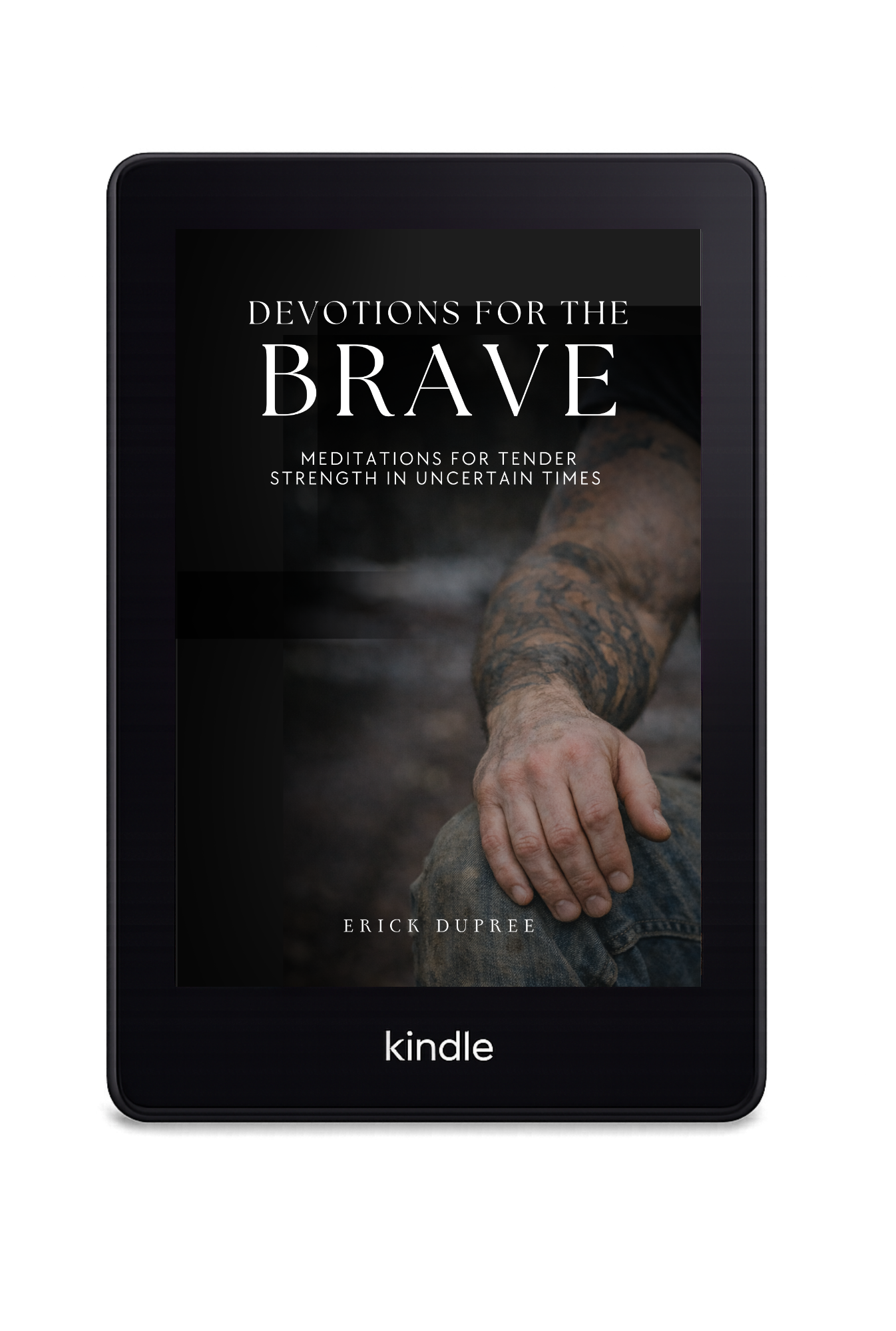
What does it mean to be brave when certainty is gone? What does it mean to stand upright inside your own life—without armor, without performance, without pretending to be finished?
Devotions for the Brave challenges the inherited ideas many of us carry about strength—ideas that equate courage with hardness, endurance with silence, and bravery with control. It invites you to slow down and reconsider what it actually means to stand upright in your own life, to feel fully without collapsing, and to remain present when certainty is unavailable.
Rather than urging you to push through difficulty or transcend it, Devotions for the Brave asks something quieter and more demanding: that you stay. That you make time and space to feel what is real in your body, to listen to what experience is teaching you, and to move forward without abandoning yourself. Its gentle insistence is that strength does not come from avoidance or performance, but from attention, restraint, and honest engagement.
Our culture offers few rituals for working with fear, desire, grief, anger, or change once we reach adulthood. We are expected to manage privately, improve quickly, and return to function without being shown how to integrate what has shaped us. Devotions for the Brave exists as a response to that absence. It treats courage as a lived practice rather than an identity, and devotion as something enacted through return rather than belief.
Written with the assurance of lived experience, Devotions for the Brave does not rush you toward resolution. It stays with discomfort long enough for clarity to emerge and for strength to mature. What arises is not certainty, but orientation—a steadier relationship to yourself, to others, and to the life you are already living.
This book includes:
Short, contemplative readings designed for return rather than completion
Reflections organized by cardinal directions, tracing cycles of strength, fire, release, and return
Language suited for meditation, prayer, or quiet reading
Space to pause, reflect, and bring the work into the body
An approach to courage that is disciplined, tender, and grounded